Which Lock Picking Skills do Special Forces and Other Operators Really Need for Operations?
- Pat Watson

- Jun 3, 2025
- 4 min read
When certifying operators in Advanced Covert Entry Operations, one of the most powerful tactical lock picking concepts that we teach is our proprietary Target Assessment skill.

One of the most useful and versatile drills that we run in our courses is our “Triangle” exercise. At its base level, we start by treating our triangle exercise as a limited choice drill which gives operators only two choices to make in order to start practicing their on-scene decision making and order of operations, aka Target Assessment.
Basic Drill:
“Two different unknown locks are placed 50m apart, and you are placed at a point 50m from both. Opening either lock will result in a successful completion. You have the choice to run to either lock and to immediately start picking that lock until completion; or you must run and assess both of the locks and then you may choose one lock to open to completion.”

Above: Option 1 - You must run to one of the locks and you may only work on that lock until it is opened.
Many of our more active and competitive, direct hard charging operators choose this first option, to sprint to either lock and to open only that one lock as fast as they can. This guarantees that the most amount of time will be spent with hands on a lock and the least amount of time will be spent on travel.

Above: Option 2 - You must travel and assess both of the locks before choosing the one lock that you will try to open to completion.
Many of our more cerebral and creative students choose the second option. This ensures that after a moderate amount of travel, the easiest lock to open will be chosen, resulting in all of the hands-on effort being applied to the best lock of the two.
This setup, along with its restrictions, is not set up as a trick but as two extremes that students should experience before starting to hone their craft towars a more operational and alive methodology.
There is no wrong answer here. This is a starting point to give students usable data in order to apply in the next stages of this drill once we start adding more variables - mimicking operations.
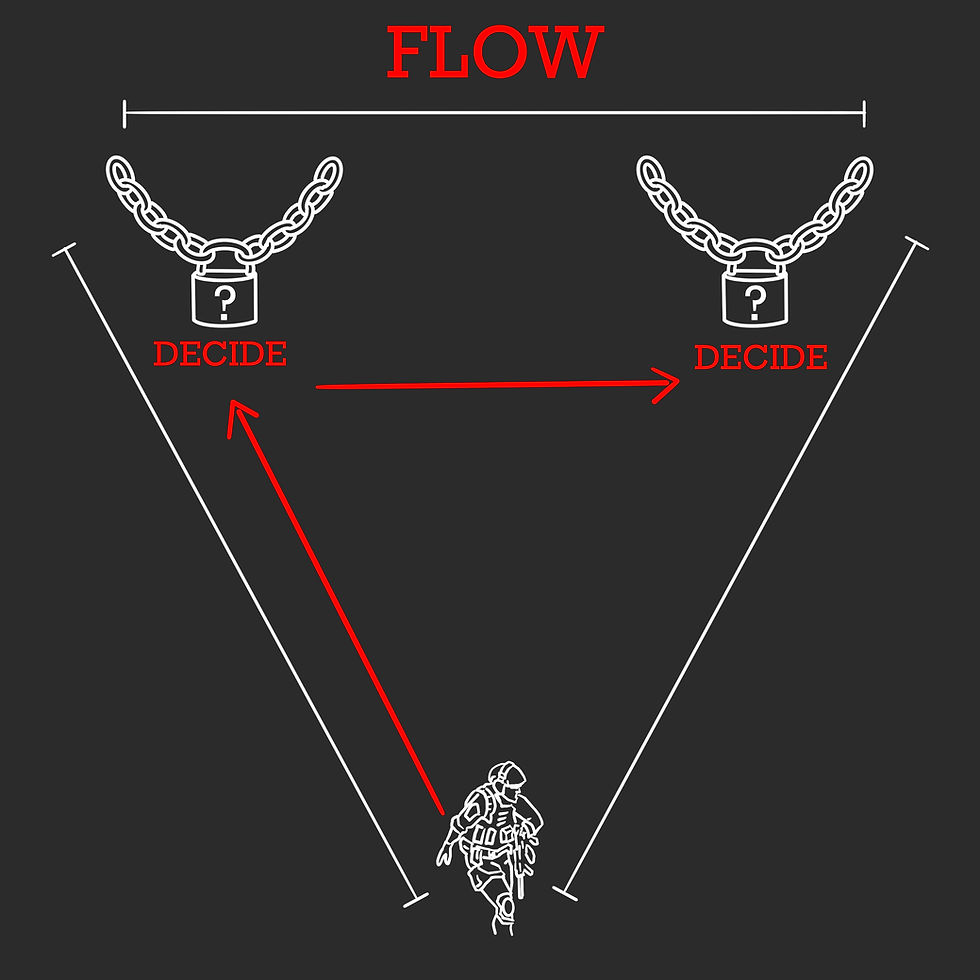
Option: Target Assessment (Field Application) - Approach a lock and assess whether you want to pick it immediately or continue your assessment; repeat.
When we take this drill one level up, we loosen the restriction of the first drill by telling operators that that they are now encouraged to run to either lock and to switch from one lock to the other at any point they choose.
The most common phrase that we hear from operators at this point in the training is “My plan is to run to the first lock and if it looks easy I will pick it, and if it looks hard I will go to the next lock and assess it, too.”
The contrast here is that operators now start to FLOW through their decision making.
This drill has an almost infinite number of variables that can be used in order to help make students operationally prepared.

Changing any ONE variable in this simple drill can have a drastic effect on the order of operations that your operator chooses - forcing the focus of the drill much more onto decision making rather than showcasing a mere "party trick" of knowing how to use a particular tool and technique on a specific lock.
You can limit the tool selection of the operator. You could move the two locks very close together or very far apart. You can make the locks a surprise to the student, or you can allow the students to do up-close “recon” on the locks and then let them plan their attack with better information for a faster entry. You can let two or three operators work together in order to get the fastest “team” entry. And much much more.
This drill is just one tiny concept that we use in our week-long operational certification courses where we teach top-tier operators Tactical Lock Picking (TLP), Non-Destructive Entry (NDE), Advanced Covert Entry Operations (ACEO), Rapid Safe Entry (RSE: opening up safes and lock boxes during operations), Vehicle Snatching (quickly acquiring vehicles for emergency operations), Lock Forensics, and more.

Some agencies and units just want a few of their operators to be introduced to some lock picking or non-destructive entry skills. This is a great step in the right direction, and some good training options for that low level of capability certainly exist.
For special forces clients and other high-level government clients that we work with, it is very important that we help them make an informed decision when it comes to seeking training and certification within this unique skill set.
It is easy to just teach a lock picking technique and then to hope that your students make good choices in the field. But, here at UTAC, we are engaged in a life-long pursuit of excellence when it comes to not just “teaching lock picking” but specifically delivering trained and certified operators that are able to make the best possible decisions in the field.
-Pat Watson
June 2025


